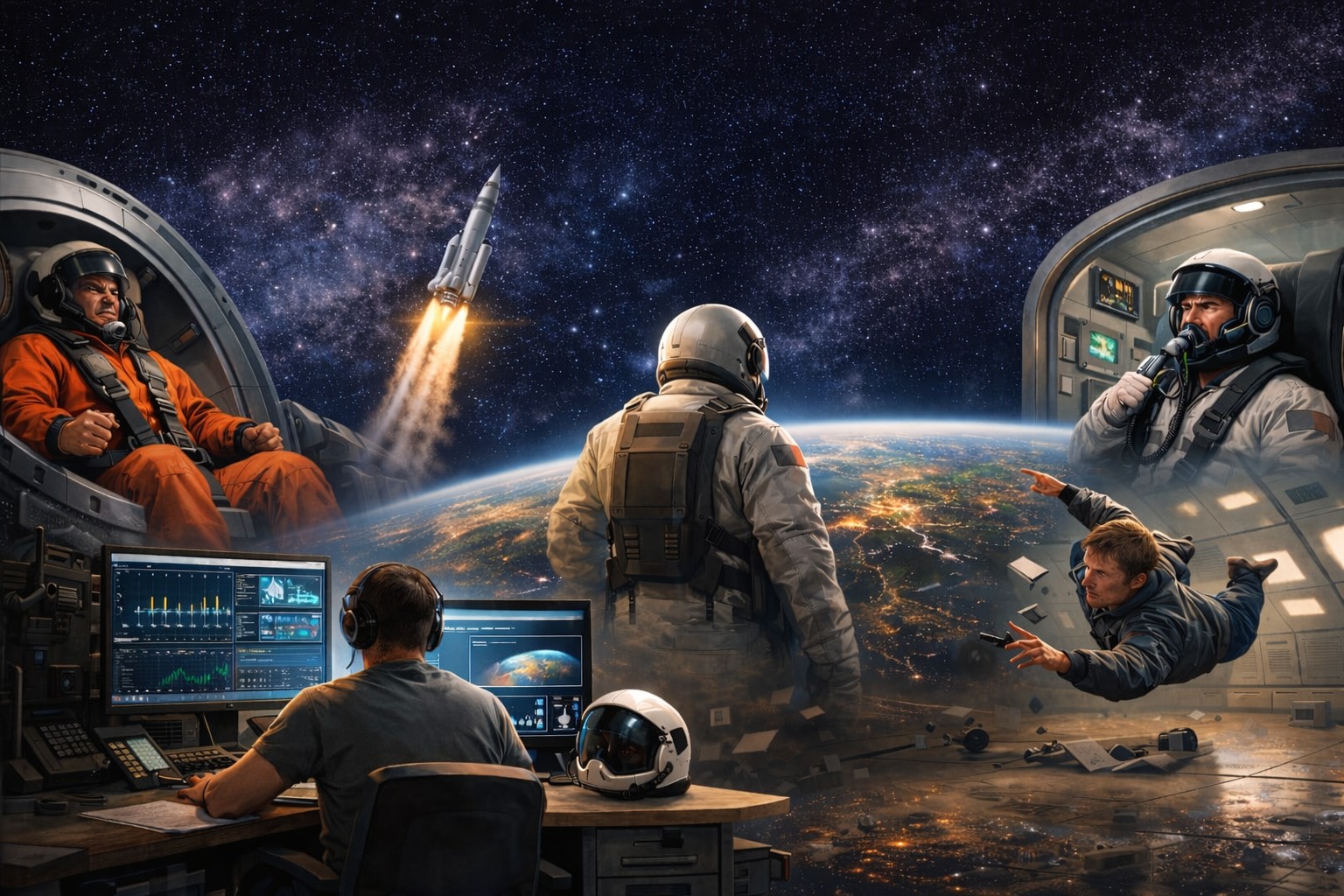
The Engineer Who Learned to Breathe Differently
I am not an astronaut in the traditional sense. I did not grow up dreaming of planting flags on distant planets, nor did I wear a government-issued badge stitched with a national emblem.
I am an engineer—one of many—working quietly within the expanding ecosystem of commercial space travel. My path to space began not with a launch countdown but with a medical form.
Commercial space tourism is often described as glamorous: panoramic windows, weightlessness, and the iconic curve of Earth. What is less discussed is the preparation required before a paying passenger or crew member is allowed anywhere near a launch vehicle. As an engineer embedded in flight systems integration, I was selected to undergo the same human-rating and training protocols as suborbital participants.
The goal was simple: understand the human body as a system under stress, just like any other engineered component.
Training started on the ground—literally. Centrifuge sessions were my first lesson in humility. As rotational speed increased, I felt my body resist physics. At around 3.5 Gs, vision narrowed. At 4 Gs, breathing became a conscious task. At 5 Gs, theory gave way to instinct. Engineers often speak of margins and tolerances; in that moment, my own margin felt dangerously thin. I learned anti-G straining techniques not as textbook knowledge but as survival behaviour.
Next came hypoxia training. Inside a controlled chamber, oxygen levels were gradually reduced to simulate cabin depressurization. I watched my hands lose coordination before my mind acknowledged danger. The most unsettling realization was how confident I felt—right up until I wasn't. It reinforced a critical truth in human spaceflight: subjective perception is unreliable under physiological stress.
Zero-gravity flights followed. During the first parabola, my inner ear revolted. Orientation vanished. Tools floated. My carefully planned movements failed. Yet by the tenth parabola, adaptation occurred. The body learned new reference points. As engineers, we design systems to be ‘human-friendly,’ but only in microgravity did I understand how deeply Earth's gravity is embedded in human behaviour.
Physical conditioning was relentless but necessary. Bone density loss, muscle atrophy, and cardiovascular adaptation are not theoretical risks; they are measurable effects. Even brief suborbital exposure demands conditioning.
Commercial spaceflight compresses these challenges into shorter timelines, but it does not eliminate them. What surprised me most was the psychological training. Claustrophobia drills. Emergency simulations. Isolation protocols. We rehearsed failure repeatedly—not to expect it, but to normalize response. In commercial space travel, reliability is essential, but resilience is equally so. The human must function when automation hands control back unexpectedly. On launch day, I did not feel awe. I felt readiness.
When the engines ignited, the vibration passed through my chest like a low-frequency equation solving itself. Acceleration pressed me into the seat, just as predicted. Systems performed within parameters. So did my body. For a few minutes, weight vanished. Earth appeared not as a symbol but as a dataset—fragile, interconnected, bounded. When we landed, applause came from outside. Inside, there was silence.
Commercial space tourism is often framed as luxury. From my perspective, it is infrastructure in development. Every tourist, every engineer, and every test flight contributes data—biological, mechanical, and operational. We are still learning how humans behave when space is no longer exceptional but accessible.
I returned to my desk the following week with sore muscles, a deeper respect for physiology, and a revised approach to design. Human factors were no longer a section in a report. They were personal.
Space did not make me feel extraordinary. It reminded me how carefully engineered survival truly is—both for machines and for the people inside them.